
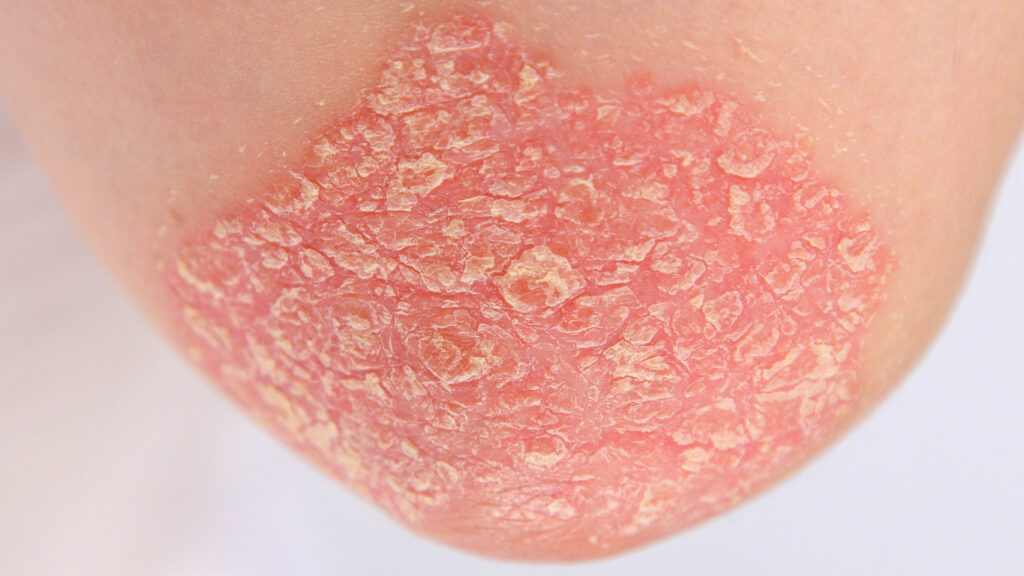
Bimekizumab (Bimzelx, UCB) maintains skin clearance for up to four years with retreatment after stopping therapy, according to new research presented at the 2026 meeting of the American Academy of Dermatology in Denver, CO.
In the BE READY Phase 3 trial/BE BRIGHT open-label extension (OLE), patients who stopped and restarted bimekizumab showed high response rates after three or more years’ retreatment, suggesting that pausing bimekizumab did not meaningfully impact long-term disease control.
Of patients treated with bimekizumab 320mg once every four weeks who achieved Psoriasis Area and Severity Index (PASI)-90 at Week 16 and stopped treatment, 31.4% maintained at least a PASI-75 response through Week 56 (approximately one year after starting treatment). Among those who lost PASI-75 response before Week 56, 63.1% achieved complete skin clearance (PASI-100) after 12 weeks of retreatment with bimekizumab. At four years, 83.6% of patients who were retreated with bimekizumab maintained complete skin clearance.
“The durability data presented out to about four years shows that bimekizumab is able to maintain excellent efficacy out to this relatively long time point, a critical point for our patients, as psoriasis is a lifetime condition,” Study Author George Han, MD, PhD, a Dermatologist at the Icahn School of Medicine at Mount Sinai in Elmhurst Hospital Center, tells The Dermatology Digest (TDD).
Setting a High Bar
“The other piece of information that I think is really compelling is the fact that the long-term data shown uses only PASI-90 and PASI-100 response rates,” he says. “This is very clinically relevant, as I feel that our goal with putting patients on systemic immunomodulators is to get them to completely clear, or at least as close as possible.”
This was considered unlikely just a few years ago, Dr. Han says. “We just have not seen data like this before from any treatment in psoriasis.”
He also points out the significance of effective retreatment, as real-world interruptions often challenge recovery due to the complexity of biologic therapies.
“Patients who were restarted on medication quickly experienced improvement and got back a high level of clearance within weeks,” he says. “I think it’s interesting to not only see this strong data on the recapture of efficacy, but to see that it was done in the context of very high standards being set to begin with.”
In a related study, 62.6% and 64.9% of those receiving bimekizumab achieved National Psoriasis Foundation (NPF)-defined on-treatment remission for at least six months in the first year.
This first consensus definition requires stringent criteria for complete skin clearance (continuous maintenance of body surface area [BSA] = 0 and Investigator’s Global Assessment [IGA]=0) to be met for at least six months.
In a post hoc analysis of the first year of BE RADIANT and BE VIVID, 62.6% and 64.9% of psoriasis patients treated with bimekizumab achieved NPF-defined on-treatment remission at some point during any six-month or longer period in the first year. At Week 28, which was the first time point that remission could be assessed in both trials, 10.4% and 12.4% of patients in BE RADIANT and BE VIVID, respectively, had achieved NPF-defined remission.
“The recent National Psoriasis Foundation definition of on-treatment remission provides clinicians with a benchmark in routine practice, helping them feel confident that those living with psoriasis can reach and maintain minimal or no disease,” says April Armstrong, MD, MPH, Professor and Chief of Dermatology at The University of California‑Los Angeles, in a news release. “Achieving complete skin clearance can ease the significant burden of symptoms and meaningfully improve daily life for those affected by this chronic condition.”
